Established history
The Events Following 1798
The surrender of Malta to the French in June 1798 deprived the Order of its territorial seat and dispersed its members across Europe.
Knights of Malta · O.S.J.
From Jerusalem to the present. The identity, history and institutional heritage of the O.S.J., rooted in the Hospitaller ideal of service.
Through the CenturiesHistory
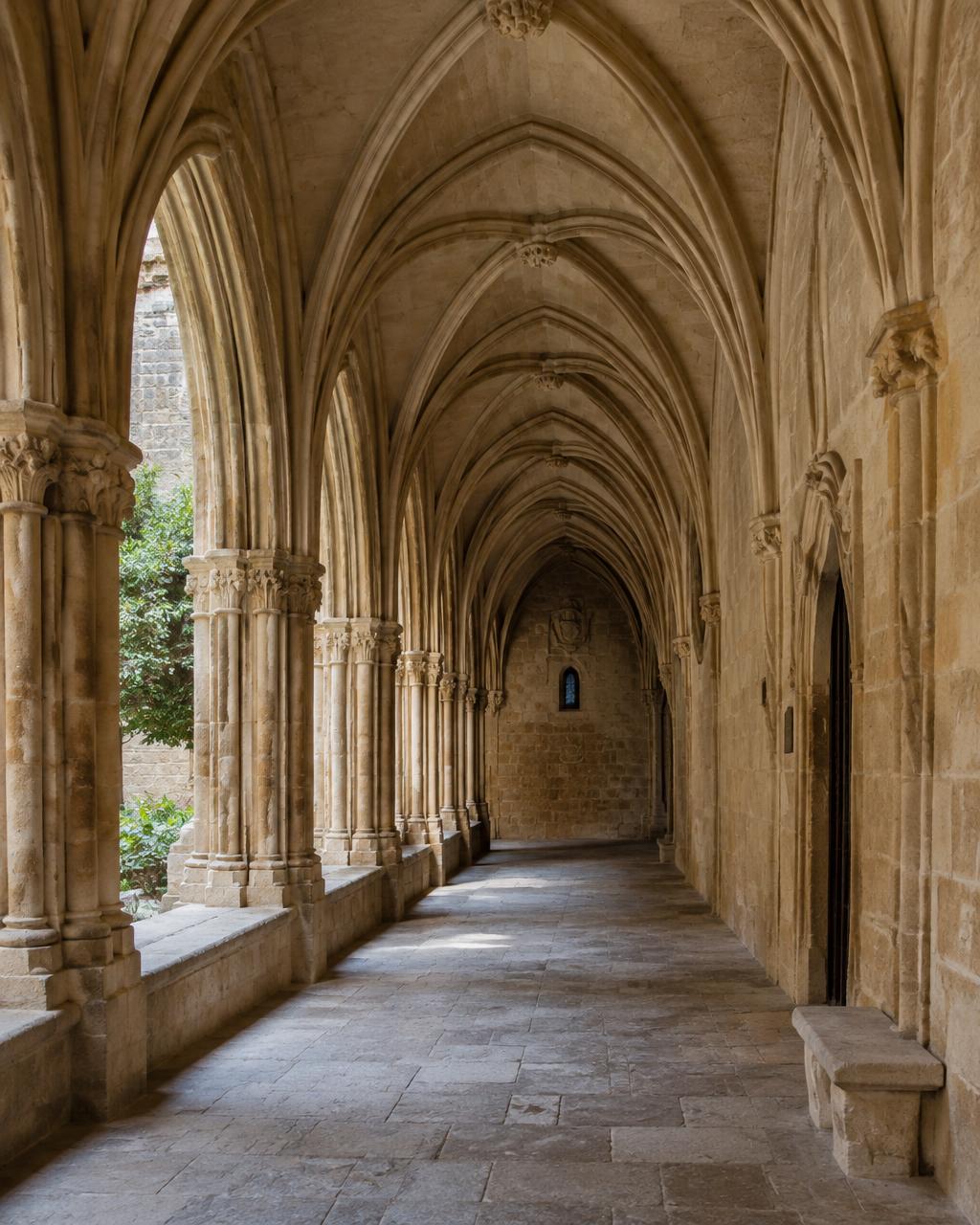
A hospice for pilgrims in Jerusalem gives rise to a community devoted to the care of the sick, a tradition associated with Blessed Gerard.
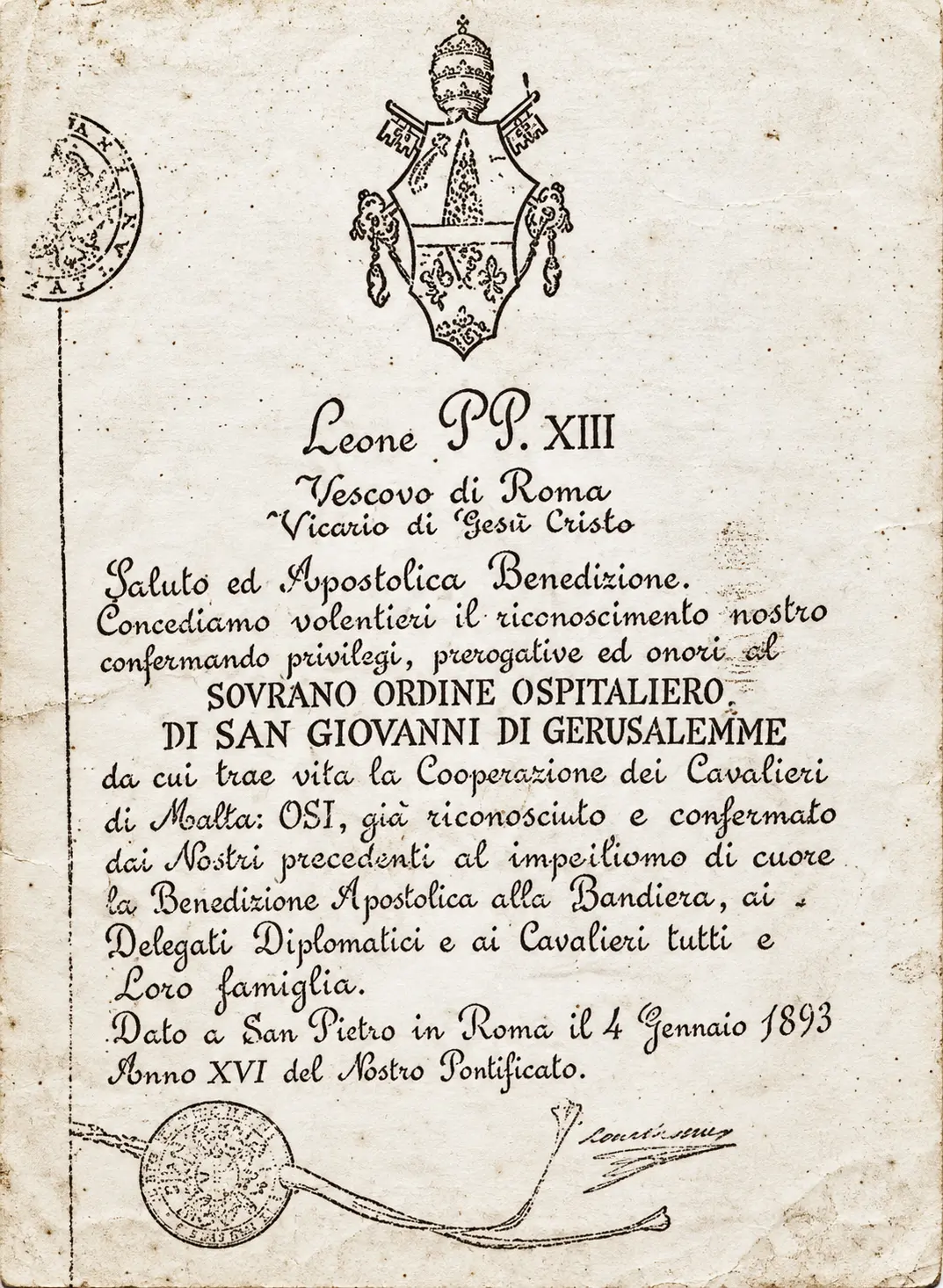
With the bull Pie Postulatio Voluntatis, Pope Paschal II takes the Hospital under the protection of the Holy See.
After the fall of Acre the Hospitallers move to Cyprus and then to Rhodes, developing their presence in the eastern Mediterranean.
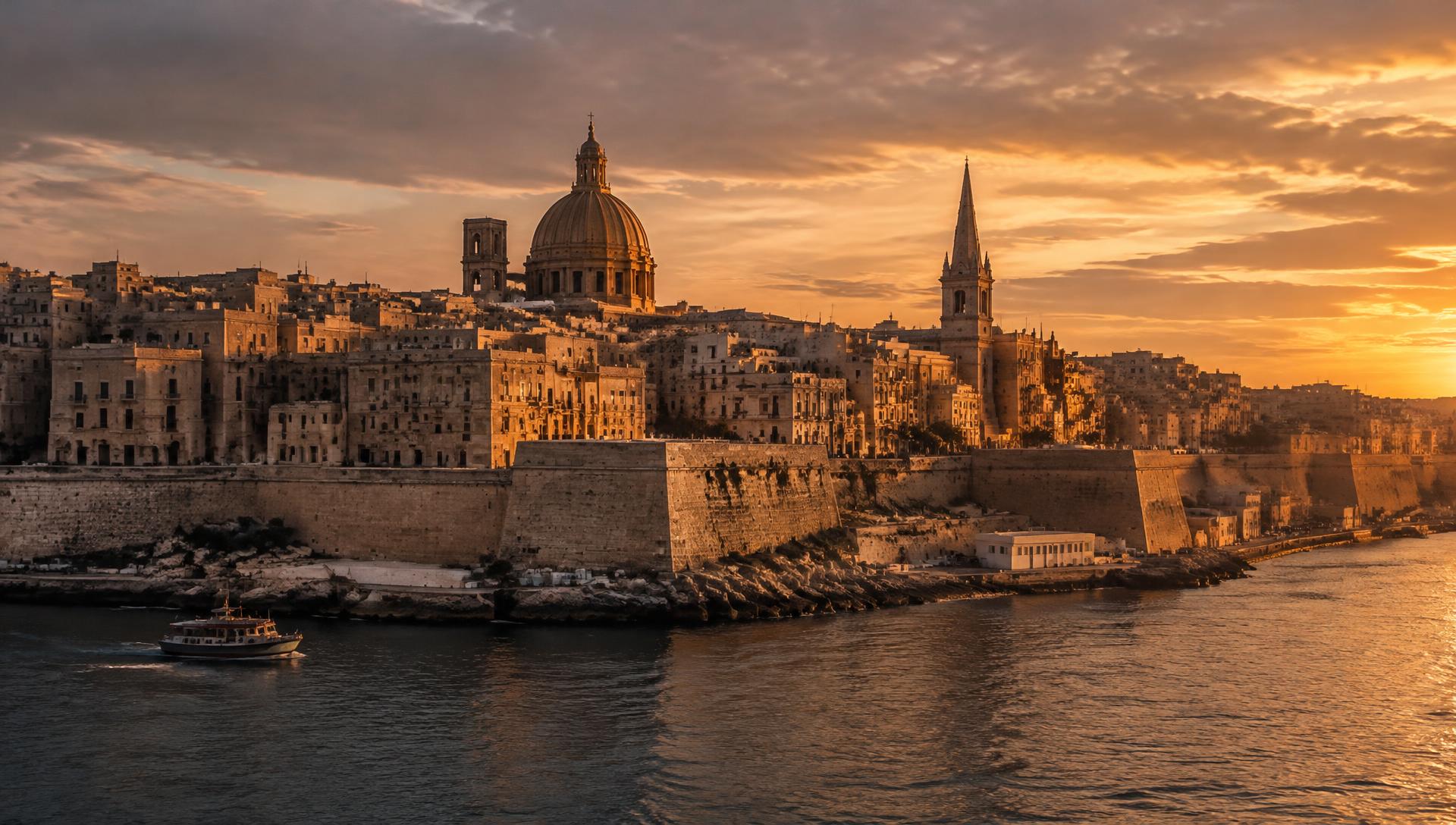
Granted Malta in 1530, the Hospitallers govern the islands for over two centuries, leaving Valletta as a lasting architectural legacy.
Napoleon's forces take Malta. The loss of the territorial seat opens a period of profound institutional transformation.
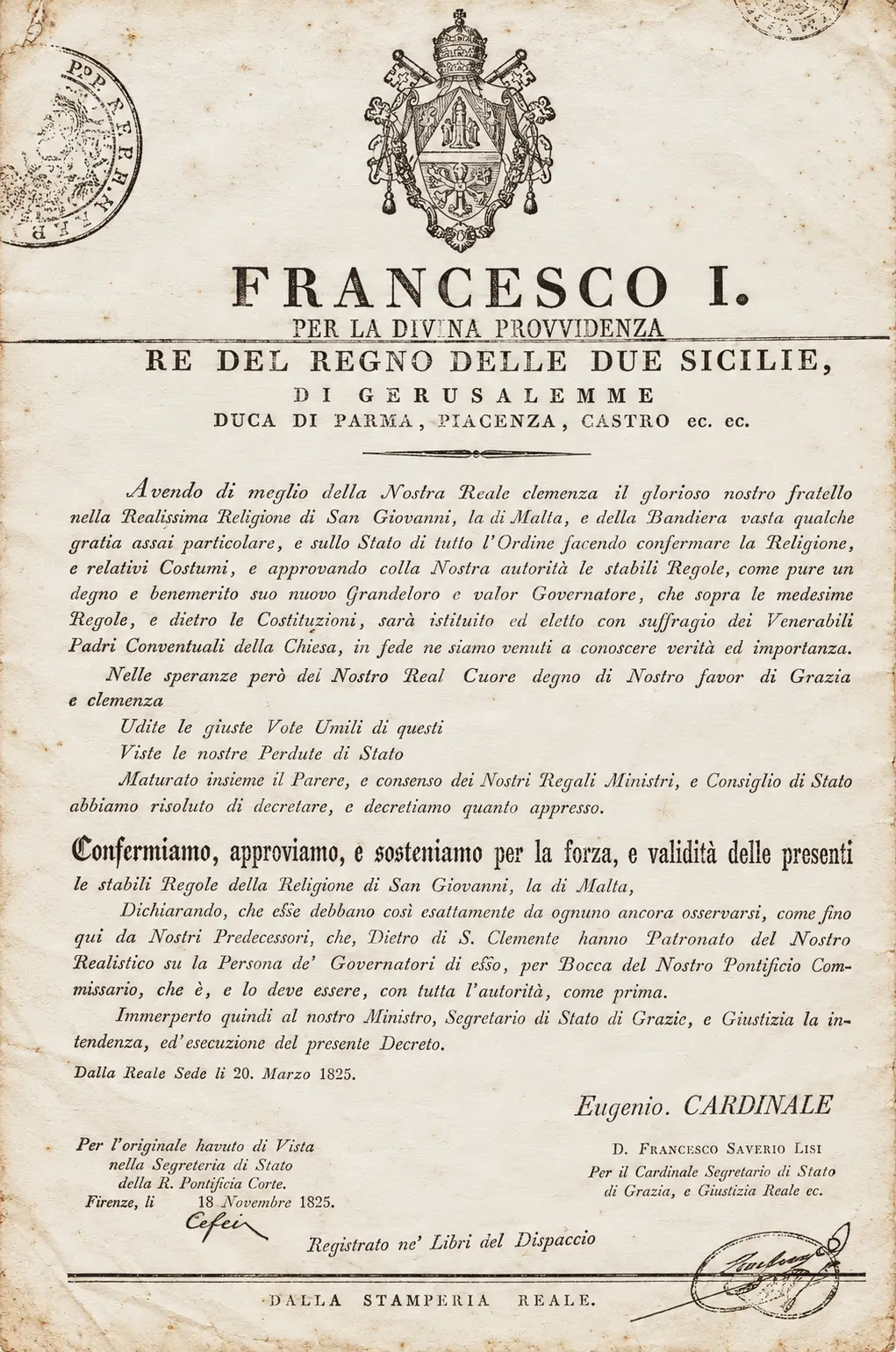
Tsar Paul I is elected Grand Master by knights in St Petersburg; Russian priories are established, and Alexander I later extends imperial protection.
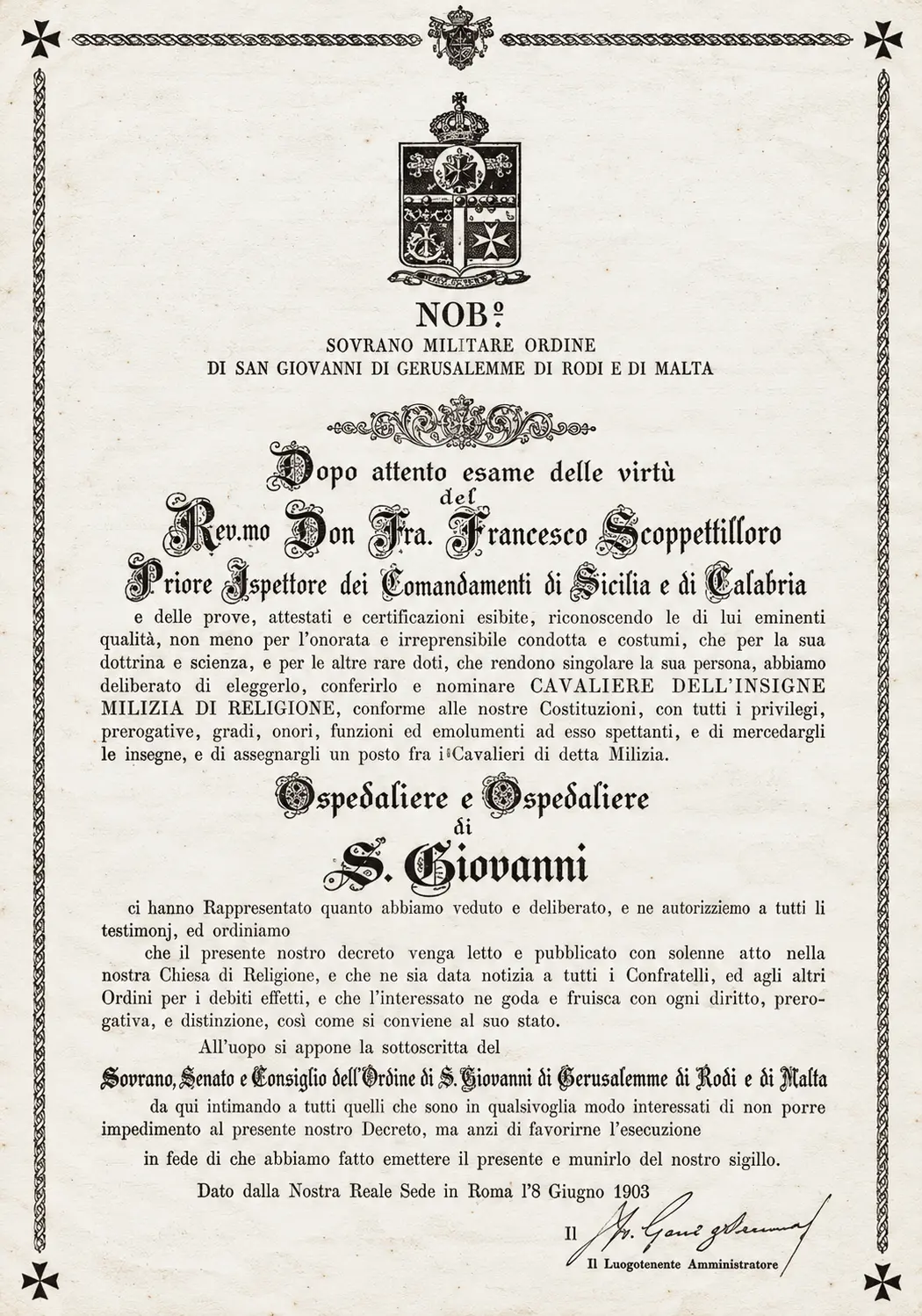
Different institutional developments emerge, accompanied by differing interpretations of historical succession.
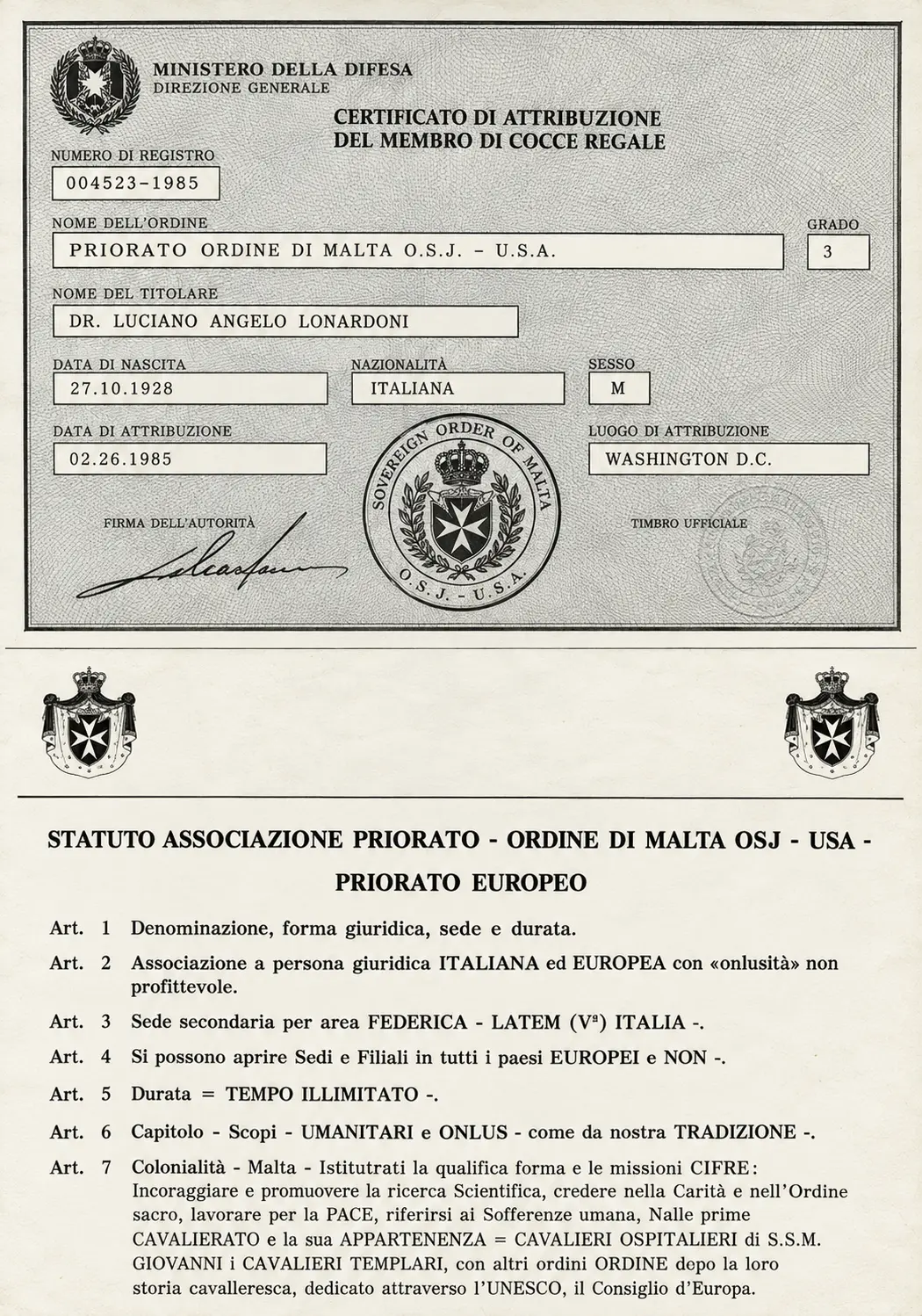
The O.S.J.'s own institutional history, statutes and stated mission, as presented by the organization.
O.S.J. institutional interpretation
According to the O.S.J. Chronicle (2024)
The following milestones are taken from the Chronicle compiled by Senator Conte Michael Lewalder (Vienna, 2024). They reflect the O.S.J.'s own account and have not been independently verified.
Historical Continuity
A documentary presentation that distinguishes established historical events from the O.S.J.'s own institutional interpretation.
Established history
The surrender of Malta to the French in June 1798 deprived the Order of its territorial seat and dispersed its members across Europe.
Established history
Russia had hosted a Grand Priory since 1797. In the crisis that followed, St Petersburg became a centre of the Order's life.
Established history
Paul I accepted the title of Grand Master in 1798. After his death in 1801, Alexander I assumed the role of protector of the Order.
Established history
The century saw the reorganisation of the Order under Lieutenants and the emergence of distinct national and confessional branches.
According to the O.S.J.
The O.S.J. traces part of its institutional history through chapters active in the United States and Europe during the 20th century, documented in its archive.
According to the O.S.J.
According to its own institutional interpretation, the O.S.J. regards itself as continuing the Hospitaller tradition through the lineage that passed via the Russian period. Other organizations hold different interpretations; this page does not adjudicate between them.
The recently added originals, whose authenticity is confirmed by the Order, enrich this account. The following summaries distinguish what each document records from the wider conclusions drawn by the O.S.J.
From the archived documents
The Sovereign Council decree of 28 April 1963 sets out the O.S.J.'s mission, spirit and governance. The letter of 7 June 1968 to Fr. Lanzarini expresses support for his initiative and connects its aims with assistance to the sick and those in need. The legal bulletin of 8 April 1963 is also preserved in the archive; its presence alone does not establish recognition of the O.S.J. Together, these sources inform the Order's account of its institutional and charitable life in this period.
Sources in the historical archive
From the archived documents
The Rome notarial record of 17 June 1979 includes the Constitutional Charter and O.S.J. Code, preserved as one eleven-page document. The Lugano record of 27 August 1979 records declarations naming Prince Amedeo Lombardi as international president and Grand Master of O.S.J.–M.AN. These records document the declarations and institutional arrangements presented at the time; they do not, by themselves, settle disputed claims of historical succession or international sovereignty.
Sources in the historical archive
From the archived documents
The Congressional Record of 2 March 1995 contains Mr. Specter's tribute, “A Tribute to the Knights of Malta for Worldwide Good Deeds”. His statement describes medical research support, hospitals, orphanages and humanitarian assistance attributed to the Order and its American foundations in several countries. The historical narrative and activities are those reported by the speaker. Publication of this tribute is not, in itself, a legal recognition of the O.S.J. or proof of its succession.
Sources in the historical archive
From the archived documents
The Gran Magistero decree of 31 December 2010, protocol 3818/2010, institutes permanent formation for members from 1 January 2011. The declaration of 13 October 2021, signed by Franco M. G. Derin, appoints Luciano Angelo Lonardoni to the function described as “Special Economic Communicator Security Officer”. The affiliations and recognition invoked in that declaration are assertions of its signatory, not independently established here. These sources add a contemporary dimension to the O.S.J.'s documentary account of its organisation.
Sources in the historical archive
From the archived documents
The undated “Vows of Knights” of the International Grand Chancellery sets out service to the poor, loyalty to the Hospitaller ideals, fellowship across denominations, genuine charity and the wearing of the eight-pointed Maltese Cross. It expresses the ethical heritage invoked by the O.S.J.; no date is assigned to it, and it is not used to establish a chronological link of succession.
Sources in the historical archive
The Order
The Sovereign Order of the Hospitallers of St. John of Jerusalem – Knights of Malta – O.S.J. identifies with the spiritual and chivalric heritage of the ancient Hospitallers and seeks to preserve its ideals in contemporary society.
01
The O.S.J. presents itself as an international chivalric organization of Christian inspiration and interconfessional vocation, gathering men and women who recognise themselves in the Hospitaller ideal.
02
From the hospice of Jerusalem onward, the Hospitallers made care for the sick and the pilgrim the heart of their vocation. The O.S.J. takes this charism of hospitality as its reference point.
03
Integrity, loyalty, humility and service: chivalry understood not as privilege but as a personal ethical commitment towards others.
04
The O.S.J. seeks to translate its heritage into present-day engagement in culture, education, dialogue and solidarity, within a transparent institutional framework.
Motto and Symbolism
For the faith, for the service of humanity.
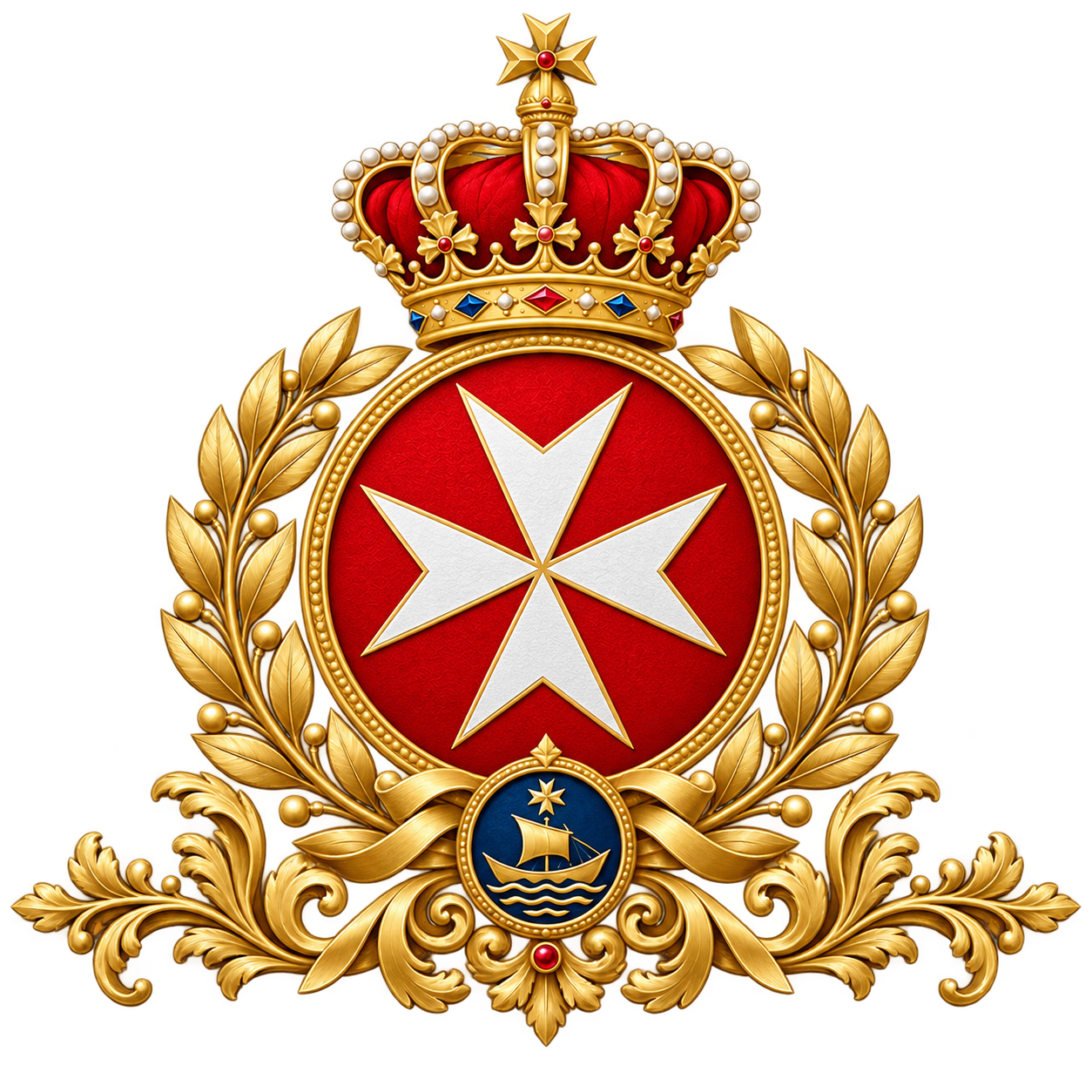
The white eight-pointed cross on a red field recalls the Hospitaller tradition: its four arms are traditionally read as the cardinal virtues, its eight points as the Beatitudes. Crown, laurel and the ship emblem complete the insignia of the O.S.J.